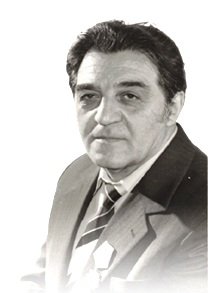
This chronicle was not written by a historian, but by a man who was himself inside the work it describes.
My father, Eng. Bedros Bakardzhiyan, was a member of the Church Boards in the periods 1998–2006 and 2010–2012 — the years of the court cases over the church’s properties, of the major repairs and of the restoration of the church. He personally dealt with many of the problems described here.
He himself warns that what is written down does not claim to be complete. Some of the people who remembered are already gone, and those who remain are fewer and fewer. That is why he sat down to write it, while there was still someone to ask.
Armenag Bakardzhiyan
“The great care, the labour and the materials given by our compatriots for the well-being of our church are, sadly, lost over time.”
The beginning
According to A. Alboyadzhiyan, as early as 1450 many Armenians moved from Kaffa to the towns of Varna, Burgas and Ruse. The Armenian Catholic bishop H. Apkaryan states that in 1610 there was already an Armenian population in the town. In 1640 there were about 200 Armenian houses in Rushchuk, whose owners were engaged in trade.
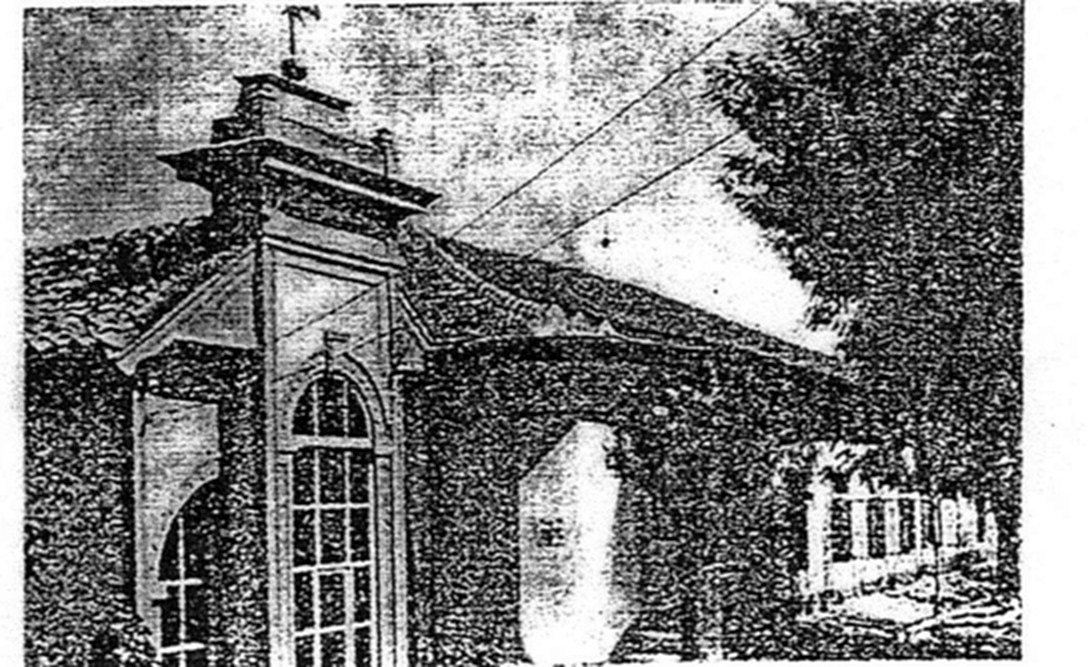
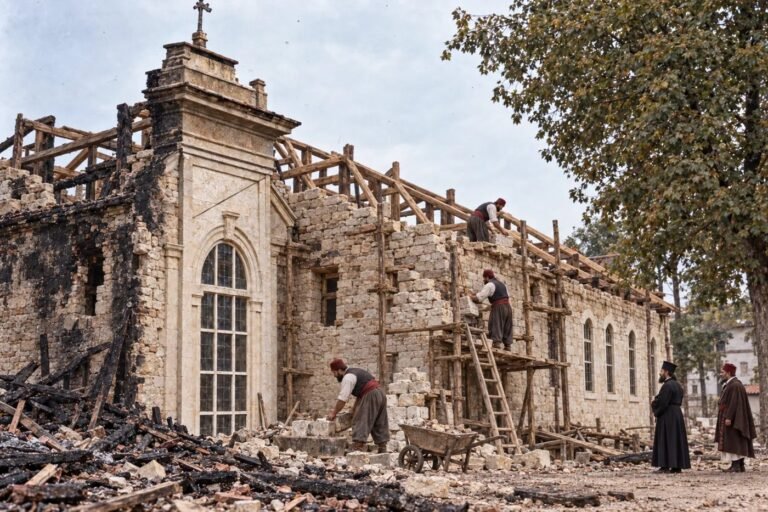
In 1812 the church burned down in a fire. In 1832 it was rebuilt, almost as it looks today, with new improvements.
From here on the chronicle follows the Church Boards — the people who, at different times, carried the responsibility for the church.
Church Board IThe years when the church simply had to survive
the socialist period, until 1991
- Baruyr Agopyan
- Hripsime Kevorkyan
- Edvard Papazyan
- Shavarsh Avedisyan
- Hayk Derderyan
- Nigr Zumrudyan
This was the period of enforced atheism. Almost all of the church’s properties were nationalised. With no income, the Church Board managed to keep the church going, and together with the priests it never stopped either the services or the church feasts.
Ringing the bells was forbidden — even on the more important Christian feasts. They rang them anyway, despite the threat of punishment.
The deacons of that time — Ardashes Minasyan, Vachen, Serop Shamasyan, Arto Zenyan — were warned by the Party organisations at their workplaces not to take part in the church liturgies. It never came to punishment. This is recorded from the personal memory of Arto Zenyan, who went through it himself.
From the scarce records of what was done in those years, the following is known: a new bell tower was built; a second brick wall with ventilation openings was built inside the prayer hall against the damp coming in through the outer stone walls — technically very well done; and a toilet block was built next to the administrative building.
In the same period the municipality expropriated the Armenian kindergarten on Nikolaevska Street — a solid two-storey building with a yard of over two decares and several shops — to build the Zhiten Klas block of flats. After a hard struggle with the state authorities, Mr Apelyan managed to obtain a two-room flat in this block for the church.
According to the memories of his wife, Takuhi Apelyan, he formed a church choir of four women, which brought a new spirit to the liturgy.
“This period may be one of the hardest, because the churches, although not closed, were rejected by the communist regime.”
Church Board IIThe first years after the change
1991 — 1992
- Hayk Artunyan
- Markar Melkonyan
- Vartuhi Muradyan
- Bohos Deridzhiryan
- Serope Garabedyan
- Mihran Hacharyan
Concrete paving was laid in the back north yard, with a channel to carry rainwater out of the church yard. The floor covering in the prayer hall and in front of the altar area was replaced with terracotta tiles.
At the end of 1992 Berdzh Filip resigned and a new Church Board was formed.
Church Board IIIThe return of the properties — and its price
1993 — 1998
- Garo Sarkisyan
- Markar Melkonyan
- Bohos Deridzhiyan
- Serop Garabedyan
- Parametsen Sarkisyan
- Sirvart Artyunyan
The democratic changes opened up new possibilities — and new difficulties.
Here the chronicle pauses to tell of the man to whom the community owes the most. The shops on Nikolaevska Street and the Armenian House “Yerevan” on Dondukov Korsakov Street were donated to the Armenian community in Ruse, through the church, by Mr Kuyumdjian — a wealthy merchant who made his donations after he had emigrated to Manchester, England. He sent his own lawyer, who drew up the notarial deeds in Bulgaria under the laws of the time.
“He was very far-sighted — he knew that through the church a property could be kept as an Armenian house.”
A contract was signed to rent out the shops in return for an obligation to carry out major repairs. The idea was a good one: after the nationalisation of 1947 the buildings had been badly managed and were in a wretched state. The contract, however, was drawn up with general clauses and later caused serious trouble.
In the same period the Saru Bair cemetery was closed down — about 12–14 decares, expropriated for a token sum. The Druzhba 3 housing estate was built on the site. Despite the stubborn refusal of the municipality, which considered that the church had no need of a home, Mr Artunyan managed to secure a two-room flat as property of the church.
With the money from the expropriation, a plot with a house on Stefan Stambolov Street was bought. The house was completely run down, and it was decided to include the property in the building of a block of flats in exchange for compensation in flats, shops and a garage. The contract was signed in 1994. The construction, however, stopped — the company went bankrupt.
The gravestones in the southern part of the church yard were put into good order. They date from the years after the church was built. It is believed that certain people were buried in the church yard — probably donors or church figures — but there is no information about them, apart from what is carved on the stones themselves.
In 1996 the Armenian House “Yerevan” was repaired.
Church Board IVEight years of courtrooms
1998 — 2006
- Eng. Bedros Bakardzhiyan
- Eng. Mihran Hacheryan
- Rupen Sarkisyan
- Takuhi Chamasyan
- Parantsen Sarkisyan
- Arman Papazyan
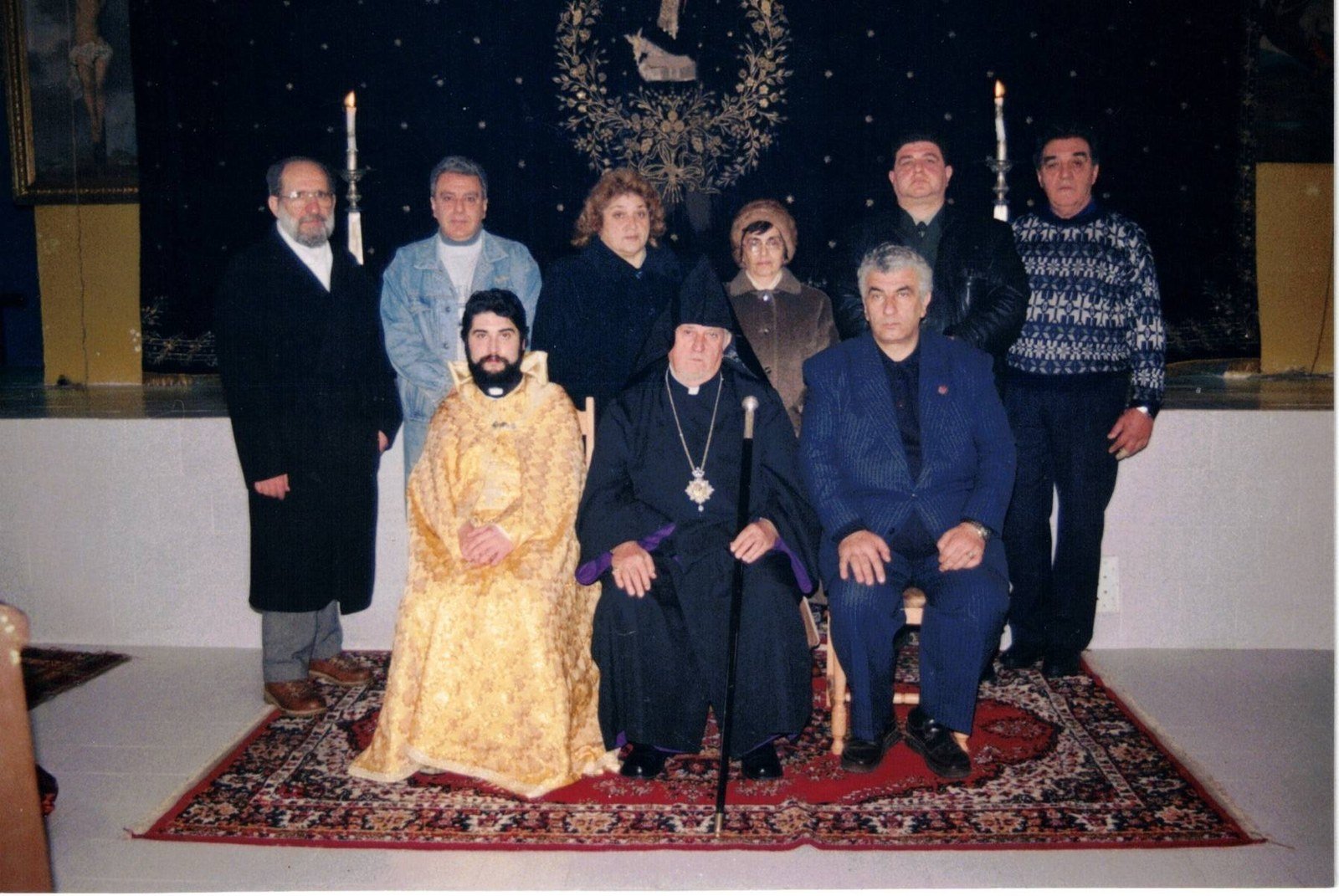
The period was marked by a crisis in the country and by bankruptcies. The frozen construction on Stefan Stambolov Street stood unfinished. In 2000, after many fruitless meetings, the Church Board filed a lawsuit to terminate the contract. Faced with the threat of losing even what had been built, the company took out a new loan and finished the building — the notarial deeds were handed over only in 2009.
In the same year a second problem appeared: the tenant of the shops went bankrupt, refused to leave and went on collecting rents without passing them on to the church. Keeping the church going became very hard.
Long cases followed in the District, Regional and Supreme Courts, until the rights of the church were restored. When the Church Board finally took possession, the building was in a tragic state, and the keys had simply been left lying there.
From then on the restoration began: separate toilets with electricity, water and drains were built in each shop; the iron shopfront frames were replaced with aluminium ones; new lighting; repairs to the roof; rooms were rearranged. By the end of 2005 the income reached a level that made it possible to bring the property into a state fit for normal use.
The flat in Druzhba 3 was accepted with an Act 16 (certificate of completion) and was rented out for a token sum to a family who had come from Armenia — a gesture of solidarity by the church, until the people could get back on their feet. For their part, over the years they made improvements to the flat at their own expense.
In the church itself during these years the roof and the eaves were repaired, to stop the leaks and to protect the valuable frescoes above the prayer hall. The roof of the house and the storeroom in the yard was replaced. The outer plaster was patched and painted. A shelter with a fireplace was built in the northern part of the yard, as well as a sturdy table for preparing the church’s feast day.
In 2000 the three altars, the details of the woodcarving and the church vessels were photographed and gathered in an album — the first systematic record of the church. A full inventory was also carried out.
The administrative building and the school. After 1950 an Armenian kindergarten opened in the administrative building, resuming its work after a break. The number of children and teachers fell — especially after the Armenian school was demolished in 1967. The kindergarten lasted until about 2016, after which it moved to the Armenian House “Yerevan”. In 2000 the building was repaired.
The genocide memorial. Because the ground around it, and the memorial itself, had cracked and sunk — the result of unsuitable building materials — in 2001 it was fully restored and faced with Greek marble. Individual elements that had been stolen or destroyed over the years were also restored. From the remains of the old facing it was found that the memorial was built in 1987 to a design by the architect Aron Karakashiyan from Sofia.
The idea of a museum. In this period the idea of a museum room was born. Many of the old books and vessels had burned in the fire. Part of what survived had been brought as relics by compatriots from Western Armenia who escaped the genocide in 1905, 1915 and 1922. The project was approved by the Ministry of Culture, as the church has been declared a historic monument. But there was no money, and the building work was put off.
The replacement of the old, completely worn-out chandeliers in the prayer hall was also planned. A company was found and a quote was received, but the money was not there. The task was left for the next Church Board.
Church Board VThe gift from New York and the silver under the paint
2006 — 2010
- Garo Sarkisyan
- Prof. Stepan Terziyan
- Eng. Hovagim Hudaverdyan
- Marionka Fendyan
- Takuhi Chamasyan
- Eng. Martin Panchev
What the previous Church Board could not finish for lack of money found a solution here — and it came from across the ocean.
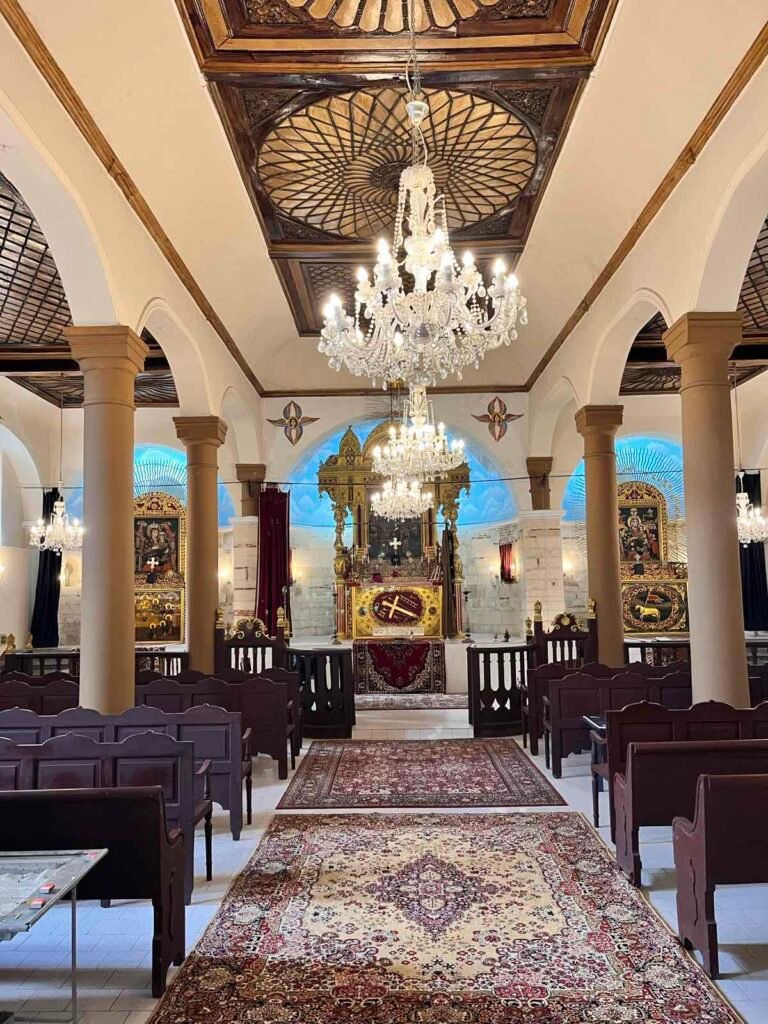
The Armenian society “Ararat” of New York, thanks to the efforts of its president, Mr Zhanet Dalyan, made a donation. In July 2006 the purchase was made. The manufacturer was tracked down thanks to Hovagim Bakardzhiyan. He also handled all the correspondence with them — from the first enquiry to the final completion of the deal — and in the end he also took part in assembling the chandeliers himself. The chandeliers arrived in parts and were assembled and installed in the prayer hall. The old central chandelier and the two small ones were restored — a difficult task, because the missing and broken parts are not sold anywhere as spare parts.
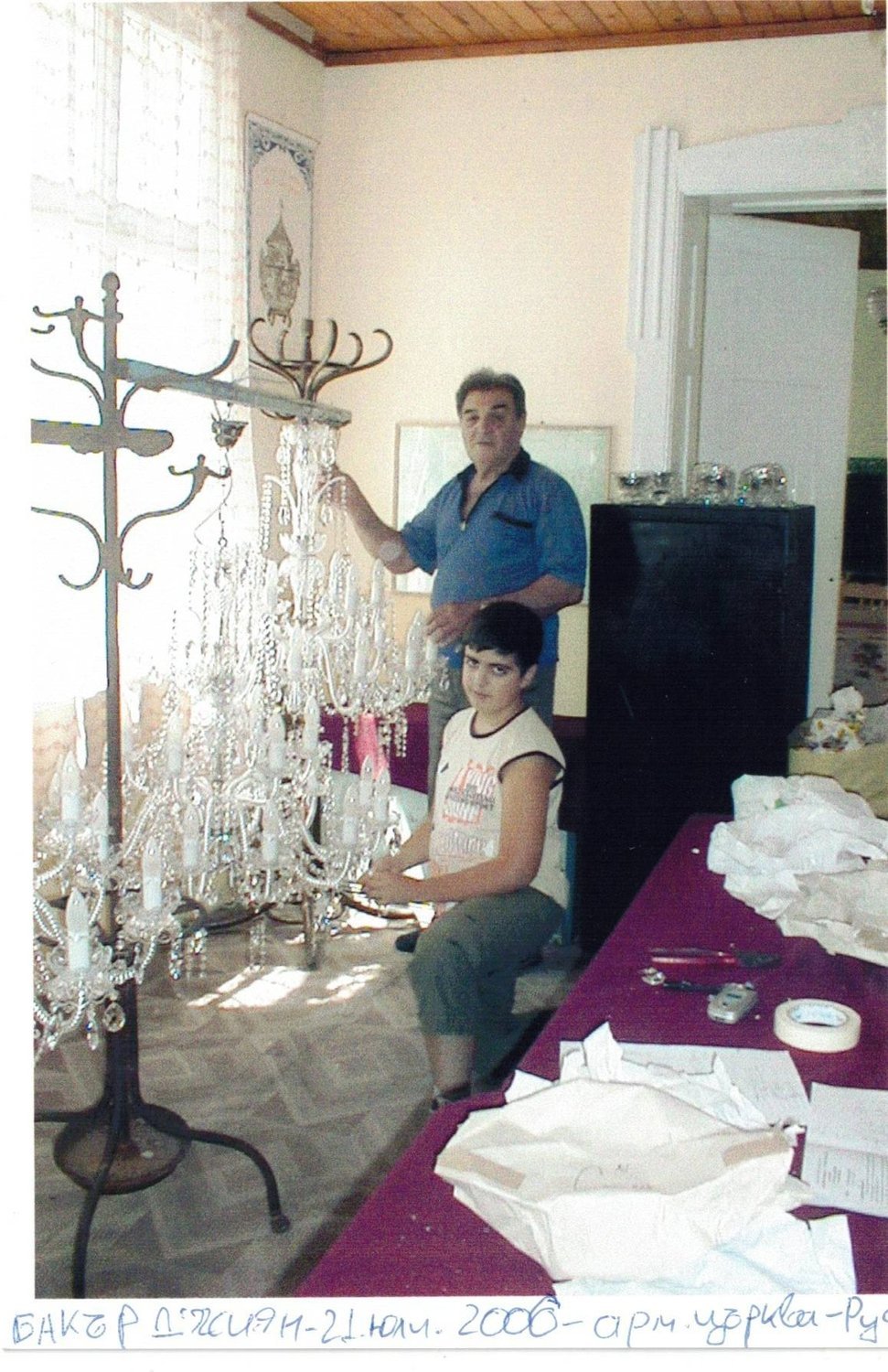
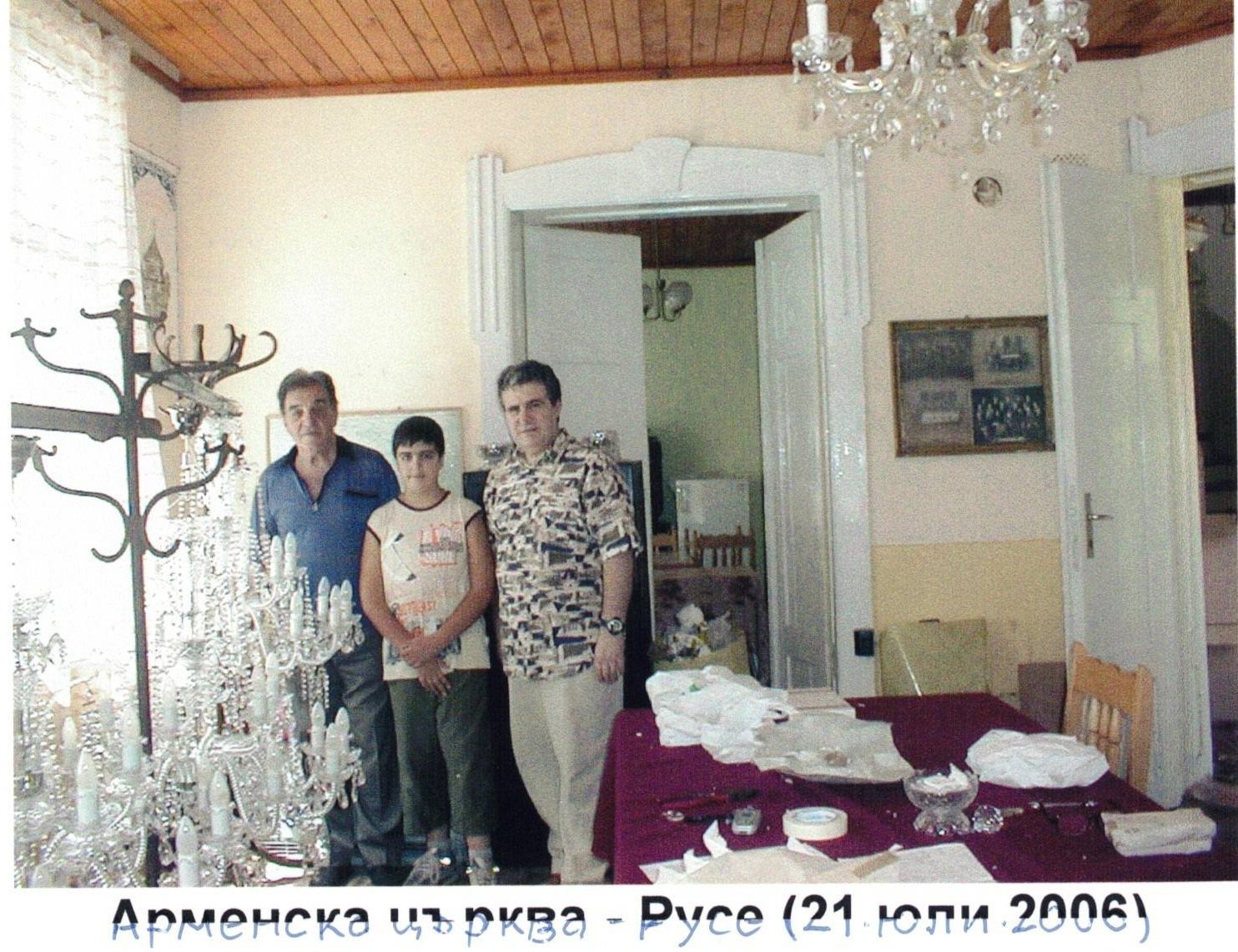
With the same donation the heating was also changed: the old stoves were scrapped and a gas system was installed.
“Heartfelt thanks to our compatriots in New York, who have not forgotten that there are many Armenians scattered around the world whose financial means are limited.”
And now the strangest story in this chronicle.
In the church there was an old chandelier which for decades had looked like a useless thing. Some time between 1945 and 1965 someone had painted it all over with oil paint and wrapped it in sticking-out cables and bulb holders — as if it were an ordinary, badly repaired light fitting.
Before it was thrown away, it was discovered by chance that under the paint it was made of silver.
Inscriptions also appeared under the layers. From them it became clear that the chandelier had been made from materials and vessels melted down after the great fire that destroyed the church. It was made at the wish of the Armenian community of Ruse, with donations, by a master goldsmith of the highest class. Its whole history is written in Armenian on the chandelier itself.
The author of the chronicle reaches a conclusion that explains everything: the disguise was most likely deliberate — to protect the object from being seized for the state around 1946, as had already happened elsewhere.
Someone decided that the safest hiding place was ugliness. And he was right — his reckoning proved correct half a century later.
At the same time, while drains were being laid in the yard, other objects were found, hidden in the ashes of an abandoned hearth. The cauldrons for preparing the Madagh (the blessed sacrificial meal) were also saved.
Church Board VIThe new look
2010 — 2012
- Prof. Stepan Terziyan
- Eng. Bedros Bakardzhiyan
- Eng. Armenag Bakardzhiyan
- Marionka Fentyan
- Harutyun Papazyan
Outside the church, the terrace above the shops and the canopy of the car service were repaired, and a new separate electricity supply with its own meters was installed for the whole property.
In the yard, the northern retaining wall on Ekzarh Yosif Street was stabilised, and on the side of the neighbouring yard — to a design by a structural engineer — a solid reinforced-concrete retaining wall was built. The old stone wall had been in danger of collapsing; this removed the risk of a landslip and of the fence being destroyed.
In 2011 the yard took on its present look. The old mud-brick fence along Ekzarh Yosif and Bratya Miladinovi Streets was pulled down and a new one was built — with the same structural and artistic value — under the direction and with the personal involvement of Harutyun Papazyan. The eastern part of the yard was cleared of stones, building rubble and overgrown bushes, and sown with grass and fruit trees. Behind the Genocide Memorial a children’s corner with benches and swings was laid out.
The columns and beams around the main entrance were scorched and restored, and the woodcarving lost over the years was brought back. All the doors and windows were replaced with new wooden frames — except the main door, which has its own historic and artistic value. The inscription above the entrance, “Surp Astvadzadzin”, was also restored, in Armenian letters made of specially chosen golden-coloured wood.
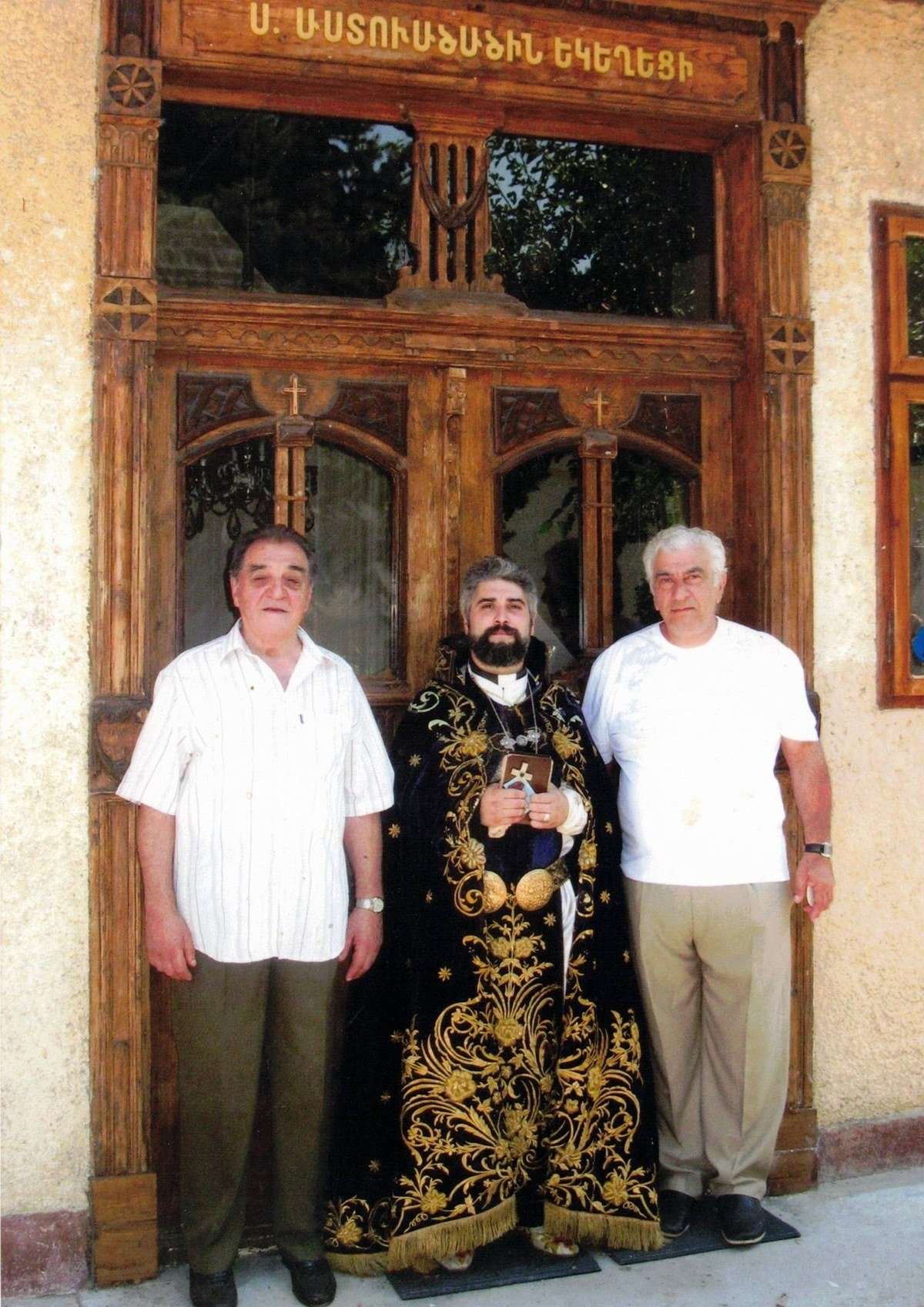
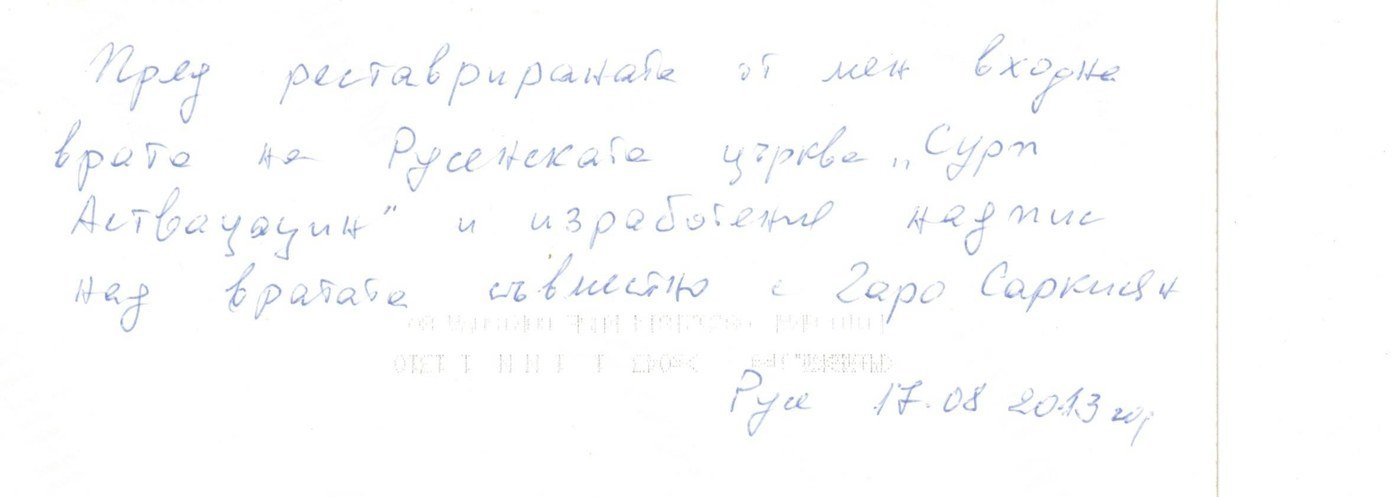
In the prayer hall about 80% of the paintings were restored and their frames replaced. Nothing is known about the painters or the donors.
“We bow before their talent and the sense of responsibility with which they worked and left these works behind them.”
Three people of our own time have donated their works to the church:
- Mrs Hacheryan from Ruse — “Christ Crucified” and “Christ Praying in the Garden of Gethsemane”
- Mrs Hadavyan from Sofia, mother of the priest Der Dirair Hadavyan — “The Baptism of Christ” and “The Baptism of King Tiridates by Gregory the Illuminator”
- Mr Gilev from Ruse — “The Descent from the Cross”
The ornaments on the ceiling were restored. The three altars were refreshed, with the main colours changed from gold and white to gold and red, following an idea of Der Dirair; the cherubim and the all-seeing eye were added. The lighting was completely replaced — spotlights are aimed at the central altar, giving a majestic look to the most important place in the hall.
Something was also done that changes the sense of the church’s age: the artificial wall in the altar area was removed, and beneath it the original stonework from the building of the church came to light.
The walls, columns and details were refreshed by a group of young people who gave their labour as volunteers. Special thanks go to Arto Lezetyan, who, also as a volunteer, finished them with great precision.
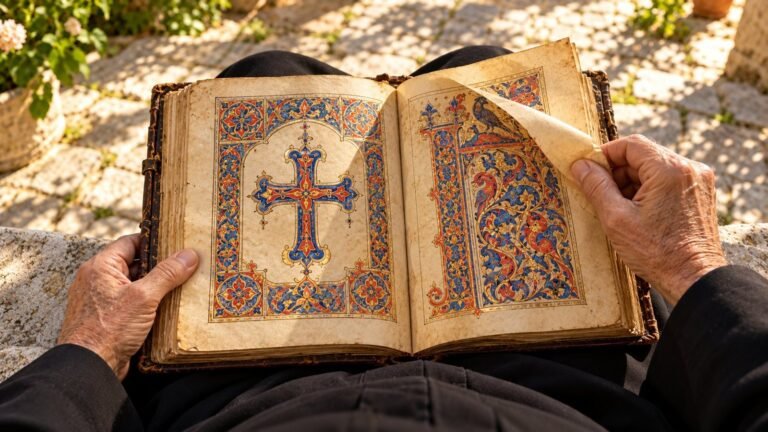
The museum. The building work, planned years earlier, began in 2006 and was completed in 2010. A large share in making it happen belongs to Eng. Bohos Shamliyan, who with great difficulty secured the necessary bank loan — at a time of economic crisis, with interest rates constantly changing. All the old books and manuscripts were treated against rot and mould and put in order. What had for decades been tucked away in cupboards was finally put on display.
And with the building of the new room, the church building, seen from above, takes the shape of a large cross.
In 2011, on behalf of the Primate’s Vicar, Father Der Dirair presented jubilee plaques marking 140 years of the Armenian Diocese in Bulgaria to Garo Sarkisyan and Bedros Bakardzhiyan — for their loyalty and dedication to the church.
In 2012 the Church Board resigned.
The clergy
From the notes of Mr Gilikyan, a historian of the diaspora in Bulgaria, and from memories, the priests who served in the church of Surp Astvadzadzin over nearly three centuries have been traced:
In 1997 Der Hagop died — the priest who, in the hardest period of enforced atheism, served faithfully and did not allow the church to be closed.
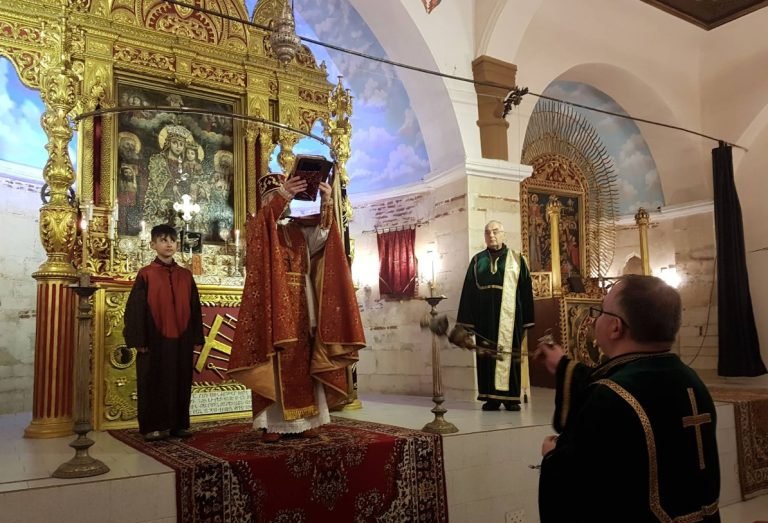
From July 1999 Der Dirair Hadavyan became the spiritual pastor of the church. In 2008 he published the Armenian Holy Liturgy in Armenian and Bulgarian — so it became understandable to the faithful, who until then had listened to the service and felt its meaning without understanding its content. By 2010 the Liturgy had been printed in booklets and distributed to the other churches of the Armenian Diocese in Bulgaria.
After 2000 several traditions became established: marking 24 April, the Day of the Armenian Genocide, organised for the first time in the town centre, with a procession to the church yard and the laying of wreaths at the Memorial; and the yearly joint prayer service of the Armenian, Catholic, Evangelical and Bulgarian Orthodox Churches for the Week of Prayer for Christian Unity.
Acknowledgements
The chronicle ends with the names of those without whom nothing described here would have been possible.
Main sponsors during the years of repairs and renewal: Bedros Pehlivanyan and Yeprem Kondayan.
The Mari and Armenag Bakardzhiyan family — for many years of supplying the church with cleaning and hygiene materials.
For building the fence and laying out the church yard:
Arman Eksiozyan · Vasken Tatevosyan · Kevork Tvapanyan · Artur Torosyan · Manuk Manukyan · Emil Enchev · Emil Tateosyan · Bohos Gardzharyan · Vladimir Beev · Karen Tatevosyan · Stepan Yeremyan
And to all the organised young people who, with their work, helped keep the church and the yard in good condition.
Afterword
After 2012 the Church Boards did not report on their work to the Armenian community in Ruse. Attention shifted to disputes within the community, and the work on the church was left without a public account.
This is written down here because the history of the church must be honest — in its strong years and in its weak ones. A church that has withstood fire, atheism and poverty deserves Church Boards that answer to the people.
May this period end soon, and may the next pages once again tell of building together.
Armenag Bakardzhiyan, 2026
This is the public edition of the chronicle. The full text, with the details of the property and the inner life of the church, is kept in the archive of the church community.
 Gallery
 Blog