
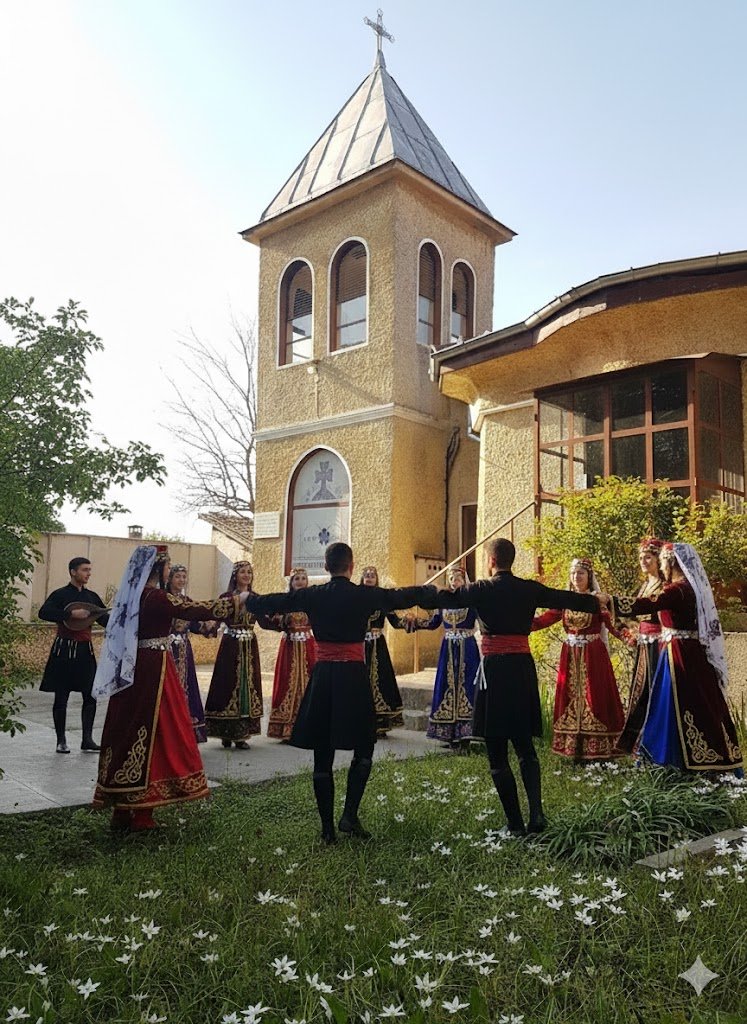
February is a month of light and of hope for Armenians. In the middle of the month, forty days after the Nativity of Christ, the Armenian Apostolic Church observes the feast of Diarnuntarach – a day that unites the spiritual meaning of the Presentation of the Lord with ancient folk customs bound up with fire, health and love.
The story behind the feast: Christ in the Temple
According to the Bible, on the fortieth day after His birth the young Jesus was brought to the Temple in Jerusalem, to be dedicated to God according to the Law of Moses. At the same time the Holy Mother of God, Mary, underwent the ritual purification and made an offering – two turtledoves, as the Law required.
In the Temple there were two righteous elders – Simeon and the prophetess Anna. Simeon had been promised that he would not die until he had seen the Saviour of the world. When he took the divine Child into his arms, he spoke prophetic words:
„Lord, now lettest thou thy servant depart in peace, according to thy word; for mine eyes have seen thy salvation, a light to lighten the Gentiles, and the glory of thy people Israel.“
The prophetess Anna, filled with the Holy Spirit, gave joyful praise to God and confirmed that the Child was the Messiah. From that time onwards newborn children are brought to the church on the fortieth day for a blessing, and mothers receive a special prayer for health, strength and spiritual protection.
The service and its symbolism
In the Armenian church the feast is marked with an evening service – the Andastan, at which the priest and his assistants make a ceremonial circuit of the four quarters of the church:
- East: a symbol of the Armenian Apostolic Church
- West: a symbol of the Christian lands
- South: a symbol of the fields, the gardens and their fruitfulness
- North: a symbol of the earth and of humanity
This circuit is not merely a rite – it is a symbol of the blessing that embraces the whole world, and of the bond between the spiritual and the material.
Fire, light and ancient customs
Although it is now fading, one of the most vivid and popular traditions of Diarnuntarach is the lighting of bonfires. In the evening people gather around great heaps of wood, which are set alight in honour of the feast. It holds a particular meaning for young families and the unmarried, who traditionally leap over the fire – a symbol of health, love, purification and good fortune.
The candles lit in the church also play an important part – they are carried into the homes, to give light to the family and to bring the grace of God. The light here carries a double symbolism:
- Christ as a light to lighten the nations
- A protecting and purifying power for people, for the family and for the home
Social and spiritual meaning
Diarnuntarach is not only a religious feast – it is also a feast of the community, uniting the generations. In the church and around the fires families, friends and neighbours gather, share blessings and delight in the festal atmosphere.
This feast is a reminder of:
- The strength of faith and hope
- The sacred light of Christ
- The blessing upon the family and the newborn
- The joining of the spiritual and the natural world
The Armenian tradition unites the liturgical and the popular, the Christian and the ancient, creating a feast of light, of love and of life.
Diarnuntarach is a feast that moves people to reflect upon spiritual values, while at the same time celebrating life, family and community. The light, the fire and the blessings of the church create an atmosphere in which faith and joy walk hand in hand.
At the end of the day, when the fire burns low and the candles glow quietly at home, Armenians remember the light that Christ brought into the world, and the strength of a tradition that binds the generations together.