
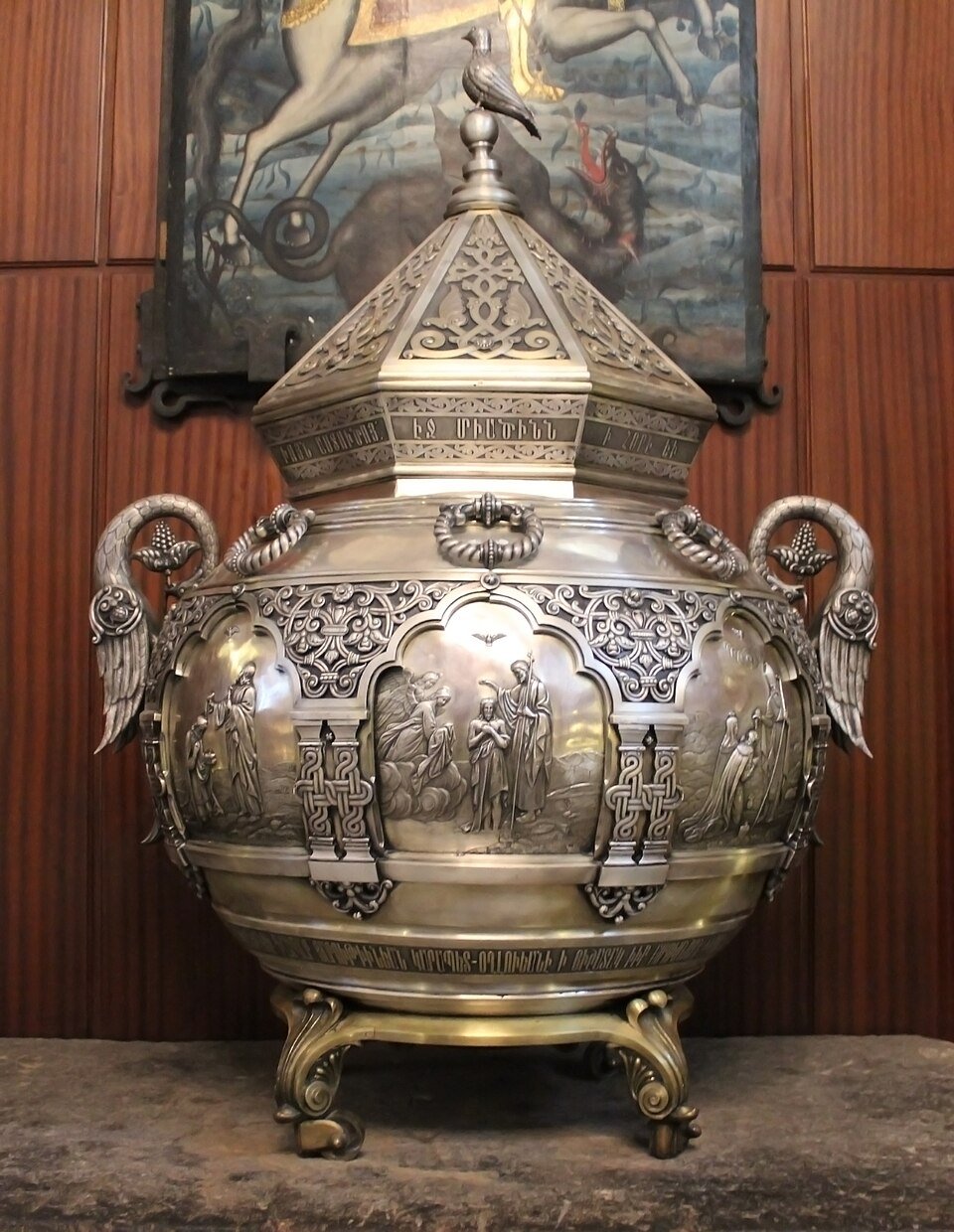
The Holy Muron (Միւռոն – Meron), the Holy Chrism of the Armenian Apostolic Church, is a fragrant consecrated oil through which the grace of the Holy Spirit is imparted. It holds a central place in the sacraments, the spiritual life and the historical memory of the Armenian people.
✝️ What the Muron is
The Muron is prepared upon a base of pure olive oil, to which are added many aromatic resins, herbs and oils – traditionally some forty ingredients. Among them are myrrh, frankincense, balsam, cinnamon, clove, saffron, rose oil and other fragrant substances from the Near East and the Caucasus.
This rich blending symbolises the fullness of God’s grace and the manifold gifts of the Holy Spirit.
📖 The biblical roots of the holy chrism
Already in the Old Testament God commands the preparation of a sacred chrism for the anointing of priests, kings and holy things (Exodus 30). It was a sign of consecration and of the presence of God.
In the New Testament anointing is bound up with the descent of the Holy Spirit. The very name Christ means „the Anointed One“. The apostles anointed the faithful as a seal of the new life in God.
From this comes the Christian sacrament of Chrismation.
🕊️ What the Muron is used for
In the Armenian Apostolic Church the Muron is used for:
• chrismation immediately after baptism
• the consecration of churches and altars
• the ordination of clergy
• the blessing of sacred objects
Baptism cleanses a person, and the Muron fills them with the gift of the Holy Spirit – the personal „Pentecost“ of every believer.
🌿 The symbolism of the fragrances and of the number forty
In the biblical tradition fragrance is a sign of God’s presence and of prayer rising towards heaven.
The many ingredients show that the grace of God acts in many ways – in consolation, in healing, in wisdom and in sanctification.
The number forty carries a deep spiritual meaning:
• the forty days of the fast of Christ
• the forty years of Israel’s journey in the wilderness
• the forty days between the Resurrection and the Ascension
It symbolises purification, preparation and the working of God.
📚 The historical development of the Muron in Armenia
After the adoption of Christianity in 301 Armenia became the first Christian state in the world. According to tradition Saint Gregory the Illuminator consecrated the first Muron at Etchmiadzin – the spiritual centre of the Armenians.
Since then the chrism has been regarded as a sign of the apostolic succession of the Church.
Through the centuries a portion of the old chrism has always been added to the new – a symbol that grace and faith are never broken off, despite persecution, war and dispersion.
In the Middle Ages formal prayers and solemn rites took shape, and the Muron was carried in procession to monasteries and villages.
Even in the periods without statehood it was the Church and the Muron that preserved the spiritual unity of the people.
🔔 The ceremony of consecration today
The consecration is performed in the cathedral of Etchmiadzin by the Catholicos of All Armenians, surrounded by bishops and clergy.
The process includes:
• long prayers and psalms
• the invocation of the Holy Spirit
• the adding of the old consecrated chrism to the new

• the solemn blessing
Afterwards the Muron is poured out and sent to every Armenian church in the world.
The vessel in which the Muron is kept in a church is called the Myuroni aman. It has the form of a dove, as a symbol of the Holy Spirit.
🏛️ How the Muron is kept and distributed
The main quantity is kept at Etchmiadzin in sealed sacred vessels near the altar. Only senior clergy have access to it.
From there it is distributed to the dioceses and local churches throughout the world. In each church it is kept in a special chrism vessel and used only for the sacraments and for blessings.
🩺 Beliefs concerning its healing power
In the Armenian tradition the Muron is also associated with spiritual healing. People have used it in sickness, for the blessing of children and homes, and in difficult moments of life.
This rests upon the biblical words concerning the anointing of the sick with oil and prayer.
The Church emphasises that it is not the oil itself that heals „magically“, but the grace of God, working through faith.
🌍 The Muron as a sign of unity
Today, when millions of Armenians live in the diaspora, the Muron remains the living link with the spiritual centre at Etchmiadzin.
One and the same sacred chrism is used in churches in Armenia, in Europe, in America and in the Near East — a powerful symbol that the Church is one, whatever the distances.
✨ In conclusion
The Muron is not merely a fragrant oil. It is:
• the seal of the Holy Spirit
• a bridge between the generations
• a witness to living faith
• the heart of the Armenian church tradition
Through it the history, the theology and the spiritual life of Armenia are woven together into one living mystery, which has continued now for more than seventeen hundred years.