
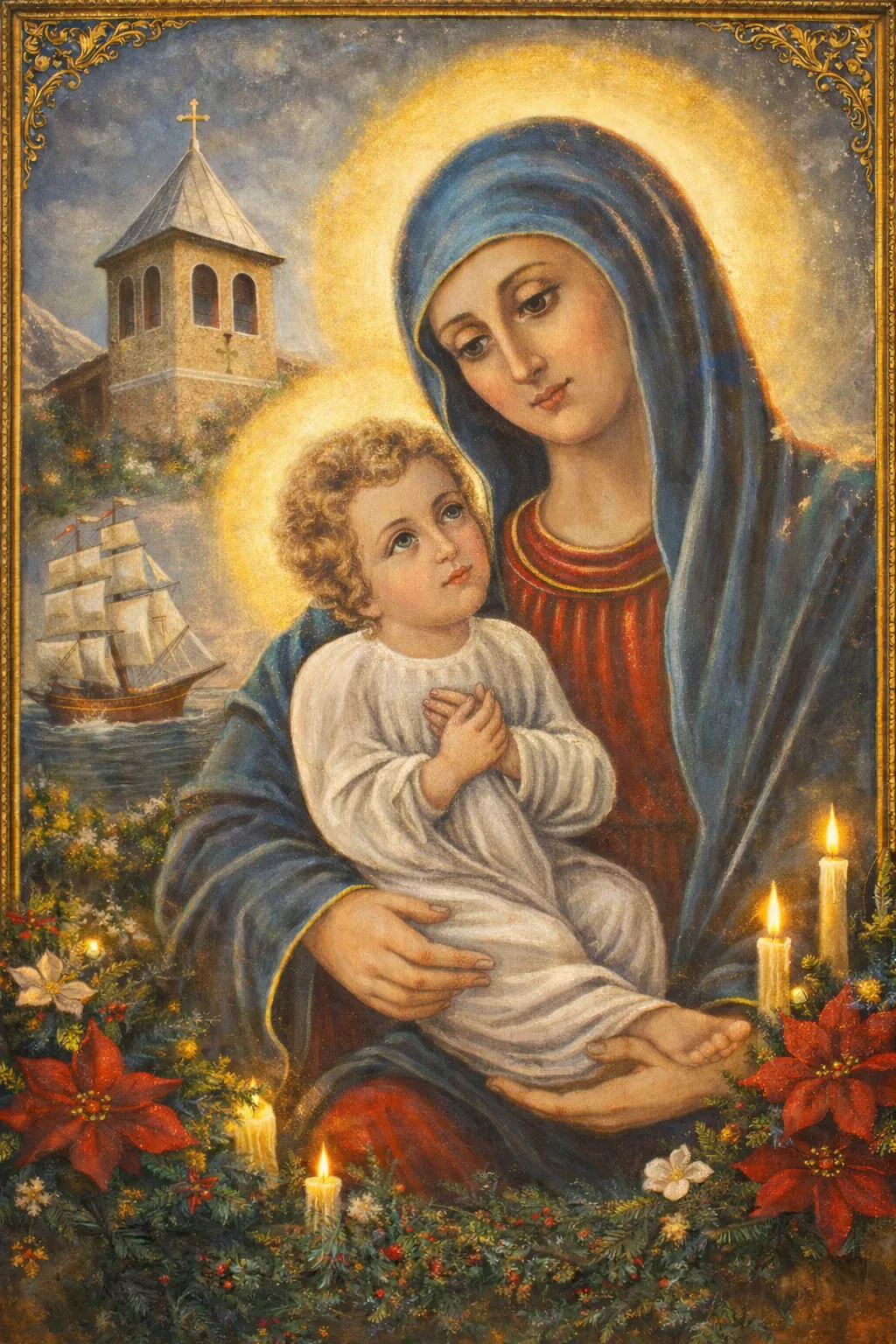
A feast of light, of faith and of new beginnings
The Nativity of Christ is the most joyful and radiant feast of the Armenian Apostolic Church. It belongs to the so-called Taghavar – the five greatest and most honoured feasts of the Church. It is with the Nativity of Christ that the new reckoning of time begins, marking the spiritual renewal of humanity.
The birth of the Saviour – a symbol of peace and love
Jesus Christ was born in Bethlehem in the humblest of circumstances and lived only thirty-three years. Despite the brevity of His earthly life, His ministry was filled with profound self-sacrifice, love for humanity and complete devotion to God. From His birth to the Crucifixion, the life of Christ remains an example of humility, mercy and spiritual strength.
For this reason the Nativity of Christ is not merely a historical event, but a feast of deep symbolism – a feast of peace, of hope and of love among people.
Why do Armenians celebrate the Nativity on 6 January?
By ancient apostolic tradition the Armenian Apostolic Church celebrates the Nativity of Christ and His Baptism (Theophany) together, on 6 January. In the first centuries all the Christian churches observed the feast on precisely this date.
Later, after 335, the Roman Catholic Church moved the celebration of the Nativity to 25 December, separating the Baptism of Christ on 6 January. The reason for this change lay in the wish of the western Church Fathers to supplant the stubbornly surviving pagan feast of the sun god Mithra (known in Armenia as Mihr), which was celebrated on that very day.
The Armenian Church, however, remained faithful to the ancient apostolic tradition, preserving the unity of the feast.
The Baptism of Jesus – the Blessing of Water
Baptism held a place of particular importance in early Christianity and is celebrated as one of the seven sacraments of the Armenian Apostolic Church. It was hallowed by John the Forerunner, called the Baptist, who preached the Theophany.
In receiving baptism in the river Jordan from John, Jesus Himself gave an example to humanity. In memory of this sacred act, on 6 January – after the festal liturgy of the Nativity – the rite of the Blessing of Water is performed.
In ancient Armenia baptism was performed beside rivers and pools, after the example of the Jordan. In time the rite came to be performed within the churches. By tradition a godparent is chosen, who makes an offering to the church for a good work, as an expression of gratitude and honour.
Jrakalouyts – the Armenian Christmas Eve (5 January)
Jrakalouyts, which means „the lighting of the lamps“, is the Armenian Christmas Eve and is always observed on 5 January.
On this day a festal liturgy is celebrated, beginning at 5.30 in the afternoon and ending around 8 in the evening. The birth of Christ is proclaimed, Communion is given, and the faithful greet one another with the joyful tidings.
After the service the congregation carry home the lighted candles from the church – a symbol of the divine light and of the blessing of the Church. These lamps recall the star of Bethlehem, which showed the three Magi the way to the infant Jesus.
The greeting on this evening runs:
„Krisdos dznav yev haydnetsav, Tsez yev mez medz avedis!“
(Christ is born and revealed among us – to you and to us, great good tidings!)
The answer is:
„Orhnyal e haydnutyun Krisdosi!“
(Blessed is the revelation of Christ!)
The table on Christmas Eve
Christmas Eve, also called Khtum or Khtumi kisher, is marked with a modest fasting supper. The table traditionally holds seven Lenten dishes, as it does at the New Year.
The supper is called „Marama jash“ – the food of Mariam, since according to tradition the Holy Mother of God herself sowed, tended and ground the seeds of the peas and chickpeas (siser). In some traditions the dishes should be predominantly white. Unlike the Bulgarian Orthodox custom, Armenian usage permits the fast to be concluded with fish.
Dznunt – Christmas (6 January)
On 6 January, the feast of Dznunt, Armenians celebrate Christmas – the first and most joyful of the Taghavar. On this day a festal liturgy is celebrated in honour of the Nativity, immediately after which the rite of Holy Baptism begins.
The priest lets fall a few drops of Holy Muron from a silver vessel shaped as a bird into the water, with which he sprinkles the faithful. The blessed water is carried home in the deep belief in its cleansing, healing and blessed power.
The spiritual meaning of the feast
For the Armenian Apostolic Church the Nativity of Christ is a feast of love among people and of peace among nations. The joining of the Nativity and the Baptism carries a profound meaning – the Armenian Christian is bound from birth to the teaching and the spiritual path of Christ.
This is a feast of light, of faith and of new beginnings – both in a person’s own life and in the history of humanity.