
The Armenian Apostolic Church of „Surp Astvadzadzin“ (the Holy Mother of God) in Ruse, first built in 1610, is one of the oldest Armenian churches in Bulgaria.
The church, set in the historic „Armenian quarter“, is significant not only for its spiritual role but also as a cultural centre for the Armenian community of the city.
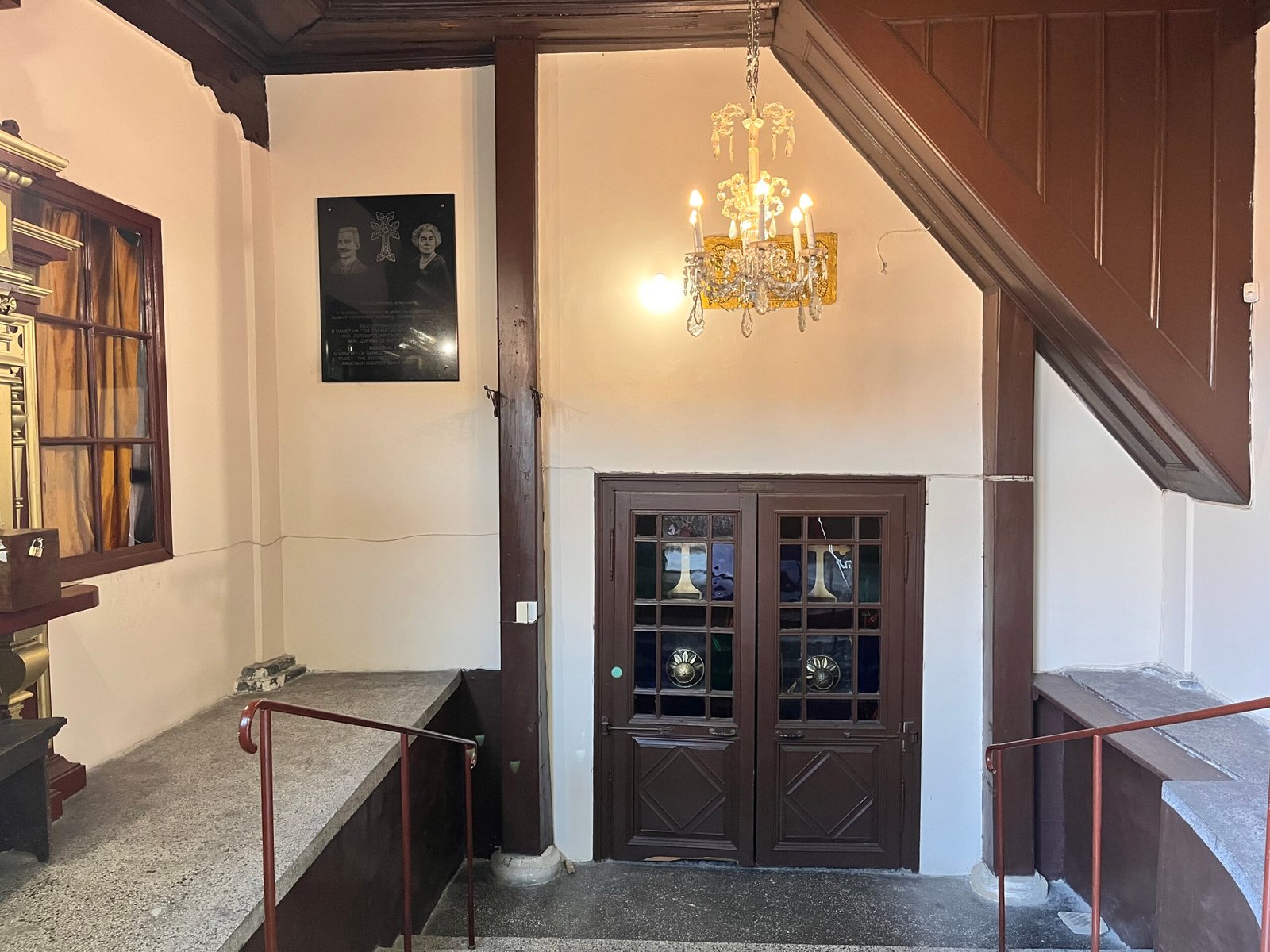
Although the architecture of the church was shaped by the conditions of Ottoman rule, the gavit – the narthex of the church – plays a key role as a space of transition between the secular and the sacred.
Architectural features of the gavit
This article examines in detail the gavit of the Armenian church in Ruse, its characteristics, its functions and its significance.
The gavit of „Surp Astvadzadzin“ in Ruse is more modest than the grand gavits of the medieval monasteries of Armenia, such as those at Geghard or Sanahin, owing to the historical and local conditions in which the church was built. Originally raised as a wooden structure in 1610, the church was burned down and rebuilt in 1832 in its present stone form. The gavit, as part of that reconstruction, was adapted to the restrictions imposed by Ottoman law, which required Christian churches to be sunk into the ground and not to exceed the height of the mosques.
- Construction: The gavit of the church in Ruse is integrated into the structure of the building, which is half sunk into the ground. It forms a compact narthex set before the entrance to the naos (the prayer hall). Because the building is sunk, the gavit lies below street level, which heightens the sense of transition from the outer world into sacred space. The walls are built of stone, and the northern wall of the churchyard incorporates elements from the late medieval period bearing graffiti inscriptions in Armenian.
- Decoration: Unlike the richly ornamented gavits of Armenia, the narthex in Ruse is more modestly decorated, reflecting the practical constraints of the Ottoman period. Even so, the space may include simple ornaments such as crosses or geometric motifs, in keeping with Armenian tradition. The church preserves valuable icons and relics, which suggests that the gavit may also have served as a place for displaying sacred objects during the rites.
- Function: The gavit was designed to hold the faithful before they entered the naos, serving as a place of gathering and of preparation for worship. Despite its more limited dimensions, it retains the traditional role of the Armenian gavit as a space of transition and of communal life.
The functions of the gavit
The gavit of „Surp Astvadzadzin“ fulfils several important functions, reflecting both the religious and the social aspects of the Armenian community in Ruse:
- Religious rites:
- The gavit serves as a place where the faithful prepare before worship, where they may gather and compose themselves spiritually. It is particularly important during the great feasts, such as Surp Astvadzadzin (the Assumption of the Holy Mother of God), when a festal liturgy is celebrated in honour of the Mother of God, patron of the church.
- In the past the gavit was probably used for smaller rites, such as baptisms or memorial services, which do not require the naos.
- Social role:
- As a centre of the Armenian community in Ruse, the gavit was a gathering place for the congregation before and after services. It made communication easier among members of the community, especially in the „Armenian quarter“, where Armenian life was concentrated.
- Amid the historical trials of Ottoman rule and the later waves of refugees after the Armenian Genocide, the gavit served as a space for preserving cultural and national identity.
- Protection and safety:
- During Ottoman rule the church was built with tunnels leading outside the city, to provide safety in the event of attack. Some of these survive to this day, and their entrance was probably reached through the gavit or the rooms nearby, which strengthens its role as a place of refuge.
- Museum function:
- In 2012, to mark the four hundredth anniversary of the church, a museum space was set aside in one of its rooms, where rare books and relics are displayed.
Historical background
The Armenian church in Ruse was built in 1610 as a wooden structure, but after a fire it was rebuilt in stone in 1832. Because of Ottoman restrictions the church was sunk into the ground, and the gavit was designed to be functional yet inconspicuous from without, so as not to draw attention. This reflects the strategy of the Armenian community to preserve its faith and traditions under foreign rule.
The gavit, though simpler than those in Armenia, was of essential importance to the community, particularly in the nineteenth and twentieth centuries, when the number of Armenians in Ruse grew with refugees from Western Armenia after the Armenian Genocide. It served as a place for strengthening the communal spirit, above all in difficult times.
Cultural and spiritual significance
The gavit of „Surp Astvadzadzin“ in Ruse is a symbol of the endurance of the Armenian community. Despite its modest dimensions and the absence of rich decoration, it fulfils the traditional role of the Armenian gavit as a space of transition between the worldly and the divine. It is a place where the faithful prepare for prayer and where the community gathers for the feasts, such as the Transfiguration (Vartavar) or Surp Astvadzadzin, which hold particular meaning for the Armenians of Ruse.
The northern wall of the churchyard, with its medieval graffiti in Armenian, adds to the historical significance of the gavit, recalling the long tradition of Armenian culture in the region. The nearness of the church to the former Armenian school „Surp Mesrob Mashtots“ further underlines the role of the gavit as a centre of education and cultural life.
In conclusion
The gavit of the Armenian church „Surp Astvadzadzin“ in Ruse is a modest but important space, reflecting both the architectural constraints of the Ottoman period and the spiritual and social needs of the Armenian community. Although it lacks the splendour of the gavits of the medieval monasteries of Armenia, it fulfils the same functions – religious, social and protective. As part of a church sunk into the ground, with tunnels for safety and historical inscriptions, the gavit stands as a witness to the endurance and the faith of the Armenians of Ruse, who have preserved their identity and traditions for more than four centuries.