
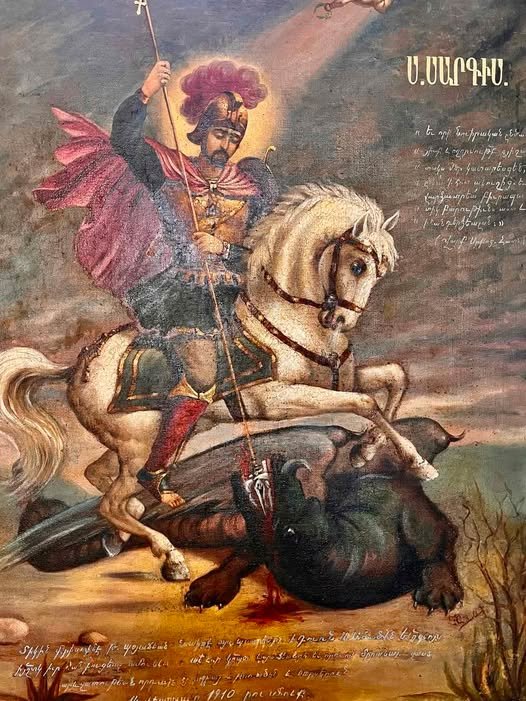
Patron of faith, of courage and of young people
Saint Sarkis, also known as Surp Sarkis Zoravar (Saint Sarkis the Commander), is one of the most venerated saints of the Armenian Apostolic Church. He lived in the fourth century and has remained in history as a symbol of unshakeable faith, of manly courage and of Christian witness.
„Neither sword nor threat can part a person from the love of Christ, when the heart is filled with faith.“
(a saying attributed by tradition to Saint Sarkis)
Soldier and Christian
Sarkis was a high-ranking soldier, appointed by the Roman Emperor Constantine the Great to service in his native province of Cappadocia. As a commander he was distinguished by honesty, by justice and by care for his soldiers, but above all by his deep Christian faith.
After the death of Constantine, power passed to the Emperor Julian the Apostate (361–363), who renounced Christianity and began persecutions against Christians. Because of the threat to his life and for the sake of his faith, Sarkis left the Roman Empire together with his son Mardiros (Martyrios).
Preaching in Armenia and service in Persia
At first they found refuge in Armenia, where Sarkis preached the word of God with zeal. Through his witness many people embraced Christianity and were baptised.
Later Sarkis went on to Persia, where the Persian Shah Shapur II (310–379) appointed him commander of the Roman-Persian frontier. Despite his high office, Sarkis remained faithful to Christ and would not submit to the pagan religious practices.
Martyrdom
In time the Shah commanded Sarkis to pay homage to the idols and to the sacred fire – a central element of the Persian religion. Sarkis refused outright. The enraged priests first killed his son Mardiros, and then led Sarkis himself outside the settlement and beheaded him.
Fourteen of his soldiers, who were also Christians, attempted to bury him with honour, but they were seized and likewise put to death for their faith.
Veneration as a saint
The martyrdom of Sarkis, Mardiros and the fourteen soldiers for the true faith is the reason for their canonisation as saints. In the fifth century Mesrob Mashtots carried the relics of Saint Sarkis from Syria into Armenia, to the settlement of Karp in the region of Van.
The feast of Saint Sarkis
The feast of Saint Sarkis is movable and falls in the period between 11 January and 15 February, after the five-day fast of Arachavorats (the Fast of the Catechumens), established by Saint Gregory the Illuminator (Surp Krikor Lusavorich).
In the Armenian tradition Saint Sarkis is venerated also as the patron of young people and of lovers. There are folk customs according to which, on the night before the feast, young people pray for love and for a blessed marriage.
The legend of Saint Sarkis and the swift horse
According to Armenian folk tradition, on the night before his feast Saint Sarkis rides over the earth upon a white horse, blessing those who seek him with a pure heart.
Young people believe that if on the eve of the feast they eat a salted cake and drink no water, Saint Sarkis will appear to them in a dream and show them their future companion in life, offering water or leading them along the path of love.
The traces of his horse’s hooves, found in flour or in snow, are held to be a sign of blessing and of a prayer fulfilled.
Name days are celebrated by:
Sarkis, Serko, Mardiros, Mardig, Mardo